October 1844: Liszt meets Caroline Dartigaux at Pau
Liszt arrived at Pau, the birthplace of “Le Bon Roi” King Henri IV, on Monday, October 7 [1], a few days later than scheduled.
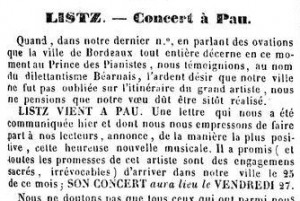
Announcement Liszt in Pau, Sept. 1844
It was at the concert on Tuesday October 8 that Liszt unexpectedly met Caroline Dartigaux, née Saint-Cricq, again. As “maîtresse de maison raffinée” of the Salon Dartigaux, Caroline was aware of Liszt’s arrival. She had her Erard grand piano transported to the Salle de Spectacle [2] in support of Liszt’s concert. Some biographers suggest that this was because Caroline rejected the grand piano at the theatre. The more likely reason was that Liszt planned on playing a duet based on themes from Norma on two pianos with his former student Madame Molina.
Madame Molina, of Spanish descent, studied several years with Liszt in Paris under her maiden name Mme. Rosario de los Hierros. She married and moved to Pau, giving several recitals in the Bearn area (e.g. Toulouse, Bayonne). For reasons of health, her husband needed to stay in Pau so Mme Molina (nickname La Melinetti by Liszt) decided to start a music school. She managed to convince Liszt to give a concert in Pau to promote her activities.
Rosario asked Liszt in a letter [3] via his mother to assist in getting an Erard piano for this event. This was not possible, but she then found Caroline’s Erard at the Salon Dartigaux. Both pianos were in good shape and tuned by a Mr. Petron to full satisfaction of Liszt, according to the Mémorial.
Thanks to the many articles [4] in the Mémorial (undoubtedly influenced by Mme. Molina) announcing this unique concert, the 800 seats at the Salle de Spectacle [5] in Pau were completely sold out. They even had to turn down requests for a hundred more seats [6]. People had travelled for up to one day from nearby towns to attend Liszt’s concert, even from Bayonne where Liszt had a concert scheduled for the following week. Ticket prices were 5 Francs [7] (Loges), 2.50 Francs (2nd row) and 2 Francs (Parterre).
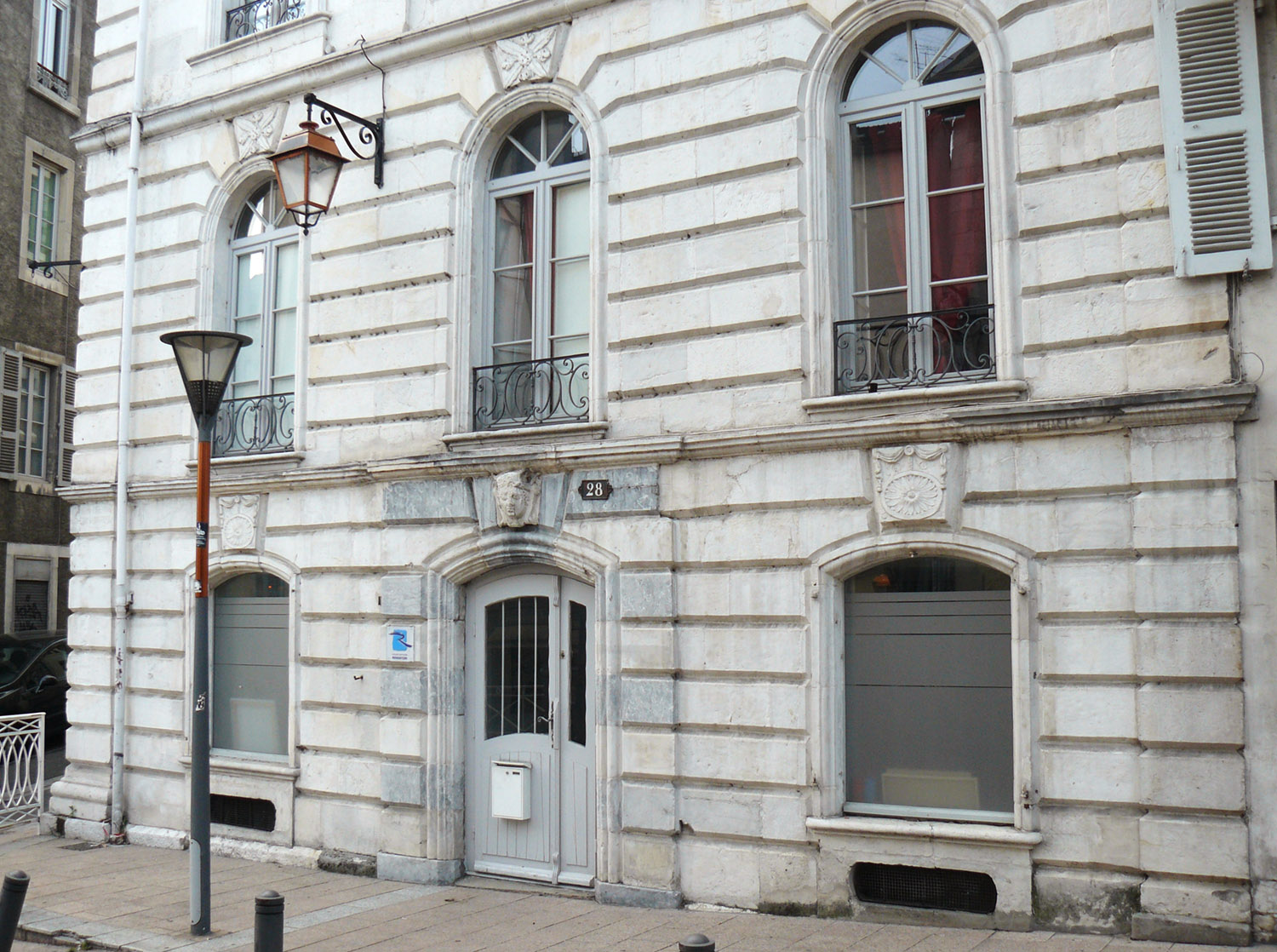
former Salle de Spectacle (presently apartment building)
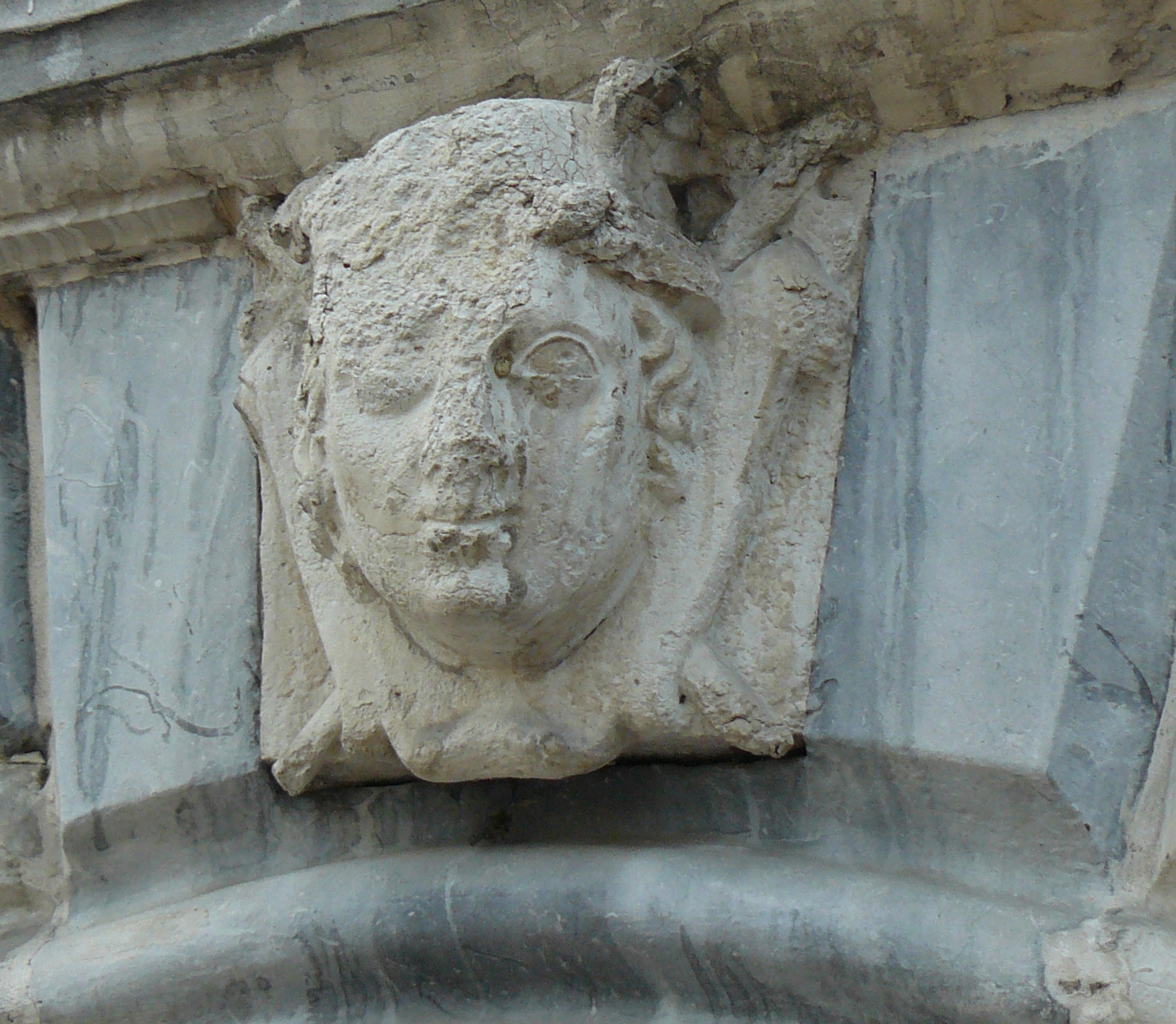
Ornament of façade of Salle de Spectacle, Pau
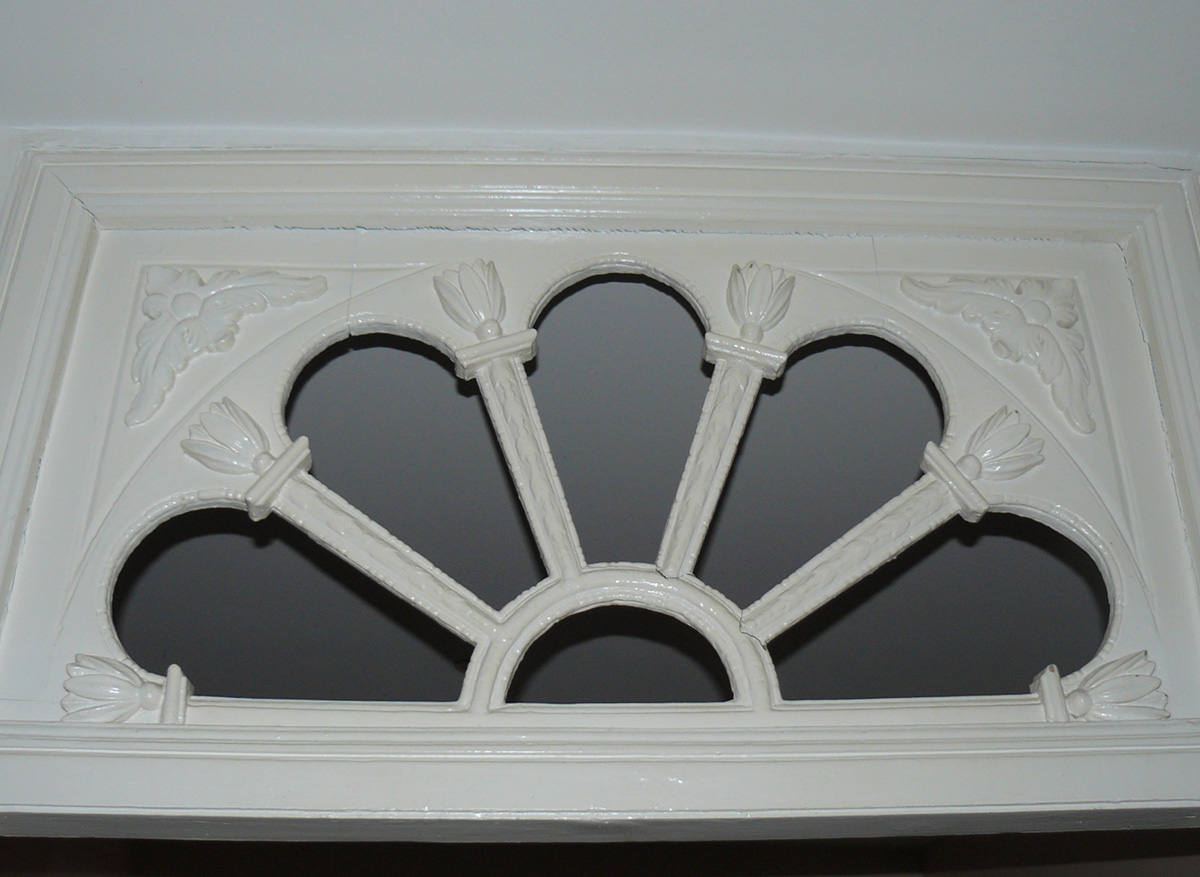
Wooden interior ornament, Salle de Spectacle
At the Pau concert, Liszt played the repertoire that was more or less standard for all his concert tours between 1839 and 1847 [8] (the virtuosity period between his relationship with Marie d’Agoult and his relationship with Carolyne von Sayn-Wittgenstein):
- Trio by Beethoven (by Messrs. Lazare, Darboville and Mme Molina – Liszt did not participate);
- Guillaume Tell Ouverture (Liszt);
- Mélodies Hongroises (Liszt)(in place of the scheduled Invitation to the Waltz by Weber);
- Etude by Chopin (Liszt);
- Fantasie on Robert le Diable (Liszt);
- Galop Chromatique (Liszt);
- Réminiscences sur la Norma (duo, Liszt with Mme. Molina).
Liszt spent the following day, October 9, at Hôtel Dartigaux [9]. The meeting with Caroline was friendly, without the uneasiness that usually exists after a broken relationship.
Sixteen years had passed since their love affair and both had established themselves in their separate lives. Caroline’s daughter Berthe was ten years old. Liszt’s three children with Marie d’Agoult, Blandine, Cosima, and Daniel were nine, seven, and five years of age, respectively.
Liszt wrote three letters [10] that week, to George Sand and his mother dated Oct. 8, and to his eldest daughter Blandine on Oct. 9. It is not reasonable to expect any reference of his encounter with Caroline in Liszt’s emotional letter to Blandine (Liszt and Marie d’Agoult were in a fierce battle over parental authority), but why not to his mother or to George Sand, who were familiar with what happened in 1828?
A second concert at the Salle de Spectacle was given on Friday October 11. As an encore, Liszt performed several brilliant improvisations on local airs including the forementioned Faribolo Pastour and one on the song La haut sus las montanhes [11] (High up in the mountains) after a poem of the Bearn poet Cyprien Despourrins (1698 – 1759). The poet Jasmin wrote: “What the Marseillaise is for the French, La haut sus las montanhes is for the Bearn region”.
The improvisations on Faribolo Pastour by Jasmin and La haut sus las montanhes by Despourrins (with subtitle Chanson Pastorale, Le Berger Malheureux) were the reason for the attending journalist of the Mémorial to print the following thank-you poem:
“In the name of all who have a Bearn heart we say thank you! You have revealed hitherto unknown beauty in our favorite song(s).”
An unexpected eye-witness account of the Pau concert was provided by an English Lady Grant. Pau was a favorite winter resort amongst the English: “Ladies find that their hair retains a curl [in Pau] much better than in England.” She overwintered in Pau from late 1843 to early 1845 and published her travel experiences in several articles in an Edinburgh journal [12].
She presented a charming view of life at Pau in those days as well as her opinion of the soirées including, very likely, Liszt’s Oct. 11 concert with improvisations on folk melodies:
“The music was not first-rate, but the instrumental part was quite creditable. The stars were the least agreeable part of the entertainment to me – they were generally pianoforte players, educated at the Academy in Paris, and for the sole purpose, apparently, of astonishing, by the rapidity of their execution. This fashion of overloading a fine air with a variety of brilliant passages, equally applicable to any melody, partakes too largely of the wonderful to please an ear formed on the purer style of the old and severer masters. It is too much a mere display of the agility of the fingers: there is nothing satisfactory in the effect produced.”
Liszt made a detour to give a concert at Bayonne on October 14 (evening concert), returning on the 15th. He met Caroline again on the 16th. On Thursday October 17, Liszt gave a charity matinee at the luxurious salon-villa of Lady Sarah Fitzgerald [13], one of the many expatriates in the area of English descent. This villa was the first English Salon at Pau and one of the cosmopolitan centres for the arts in the Pau region.
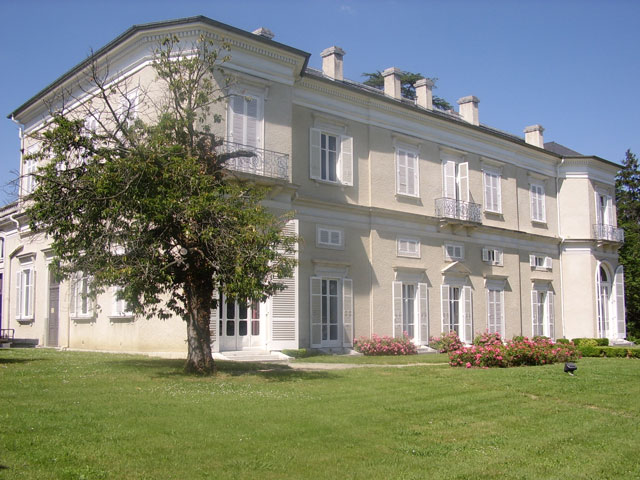
Salon Lady Sarah Fitzgerald at Pau, presently a college
Liszt handled the collection for the poor personally (which obviously resulted in larger donations from the audience) and raised over 500 Francs. The next day he travelled to Bayonne again for another charity matinee on October 18th.
We know that Liszt was touched by the unexpected encounter with his former love. On the morning of the 19th in Bayonne, Liszt prepared to send Caroline a thank-you gift.
He sent a letter [14] to his mother asking her to have a large turquoise talisman that he had purchased in St. Petersburg to be delivered to a renowned jeweller in Paris. He also sent a letter to the jeweller, a Mr. Maurice Froment, asking him to set the jewel in an appropriate bracelet and return it to his mother, preferably within a fortnight. Did the talisman ever reach Caroline? We’ll discuss this in the next section.
Some months later Liszt bought a white burnous in Spain as another present for Caroline. He wrote to his mother that she would soon receive it and asked her to have it delivered, tastefully wrapped, to a Mr. Antoine Lenain (family of Caroline’s mother and court officer in Paris) to have it sent to Caroline at Pau.
Liszt departed from Bayonne to Spain on the 19th [15] (via the “Camino Real” via Vitoria-Gasteiz and Burgos) expecting to arrive after 54 – 58 hours of travel in Madrid on October 22nd.
Two months later Liszt mentioned Caroline again in two letters [16] that he wrote from Spain:
- In letter 389 (reference by La Mara) written in Seville, on December 27, 1844, to La Melinetti (a nickname for his former pupil Molina) he says:
“I have found the most delightful [surprise] — the letter from Mademoiselle Caroline. Thanks to her charming lines, I found myself in the best possible frame of mind for the enjoyment of all imaginable chefs d’oeuvre, and I could not have been more disposed to admiration and wonderment!”
- In letter 390 he talked about Mme Melinetti (Molina), who was trying to set up her music school in Pau, and stated:
“La Melinetti will doubtless have given you my ancient news from Pau! [ … ] With a little wit, good manners, and tact, she could gain herself a very good position in Pau. Mme. d’Artigaux, who is the most ideally good woman I know, takes a real interest in her.”
The recipient apparently knew both Madame Molina and Chopin, because Liszt asked the person to inform him about Chopin’s health, since he did not get an answer from George Sand on his earlier letter of Oct. 8 that year. Based on Liszt’s stay with Princess Belgiojoso that Spring, and with the Princess being a confidante of George Sand and Chopin, she was the most likely recipient of this letter.
It was during his two-week stay in Pau that Liszt wrote down the musical score of his improvisations on the songs of Jasmin and Despourrins and dedicated them to his adolescence love Caroline Dartigaux, née Saint-Cricq [17].
Like Jasmin’s Franconnette, the poem La haut sus las montanhes by Despourrins is also about a problematic love affair. Liszt captured his improvisation on this song in his Pastorale de Bearn composition. Liszt acknowledged his familiarity with Jasmin and the poem Franconnette by referring to these in the Faribolo Pastour title: “Chanson tirée du Poème de Franconnetto de Jasmin”. His Pastorale de Bearn lacked this type of reference (to Despourrins). This hints that Liszt may not have been familiar with its content.
A third and fourth local air on which Liszt improvised [18] during this 1844 French concert tour were the ancient songs Campana que sona which he transcribed into La cloche sonne (S. 238) and a work by 17th century composer Nicolas Saboly which he later transcribed as his Old Provençal Christmas Song in his Christmas Tree album. Many local songs that Liszt encountered during this and other concert tours sooner or later found their way into paraphrases or were incorporated in new compositions. In that respect we can see Liszt as a musical equivalent of the Brothers Grimm, who started collecting local folk stories earlier that century.
Next: Faribolo Pastour Composition
[1][↑] Memorial des Pyrénées, 30e Année, Oct. 7, 1844 ; Charles Blanc, “Le centenaire des concerts données par Franz Liszt à Pau, 1844-1944”, in Bulletin de la Société des Sciences, Lettres et Arts de Pau, 1946.
[2][↑] Michel Fabre, “Liszt et Planté: Le premier amour et le dernier concert”, La Revue internationale de musique francaise, Vol 16, February 1985, Slatkine, Paris, p 107-114. This article also provides many other details on Liszt’s concerts at Pau. A common romantic fable is that the Erard piano that Liszt played on in Pau was the same instrument he played with Caroline at her Paris home in 1828. Unfortunately for this touching story, the instrument numbers do not match. The Dartigaux Erard piano, presently displayed at the Betharram museum, was procured in 1868. Liszt never played it.
[3][↑] Klara Hamburger, Franz Liszt, Anna Maria Liszt, Briefwechsel mit seiner Mutter, Amt der Burgenländischen Landesregierung, Eisenstadt, 2000. We can read about the efforts to arrange for this piano in Anna Liszt’s letter from Paris (April 1844), A 9, p. 388 and Liszt’s letter from Nimes, Aug. 9, 1844, F43, p. 150.
[4][↑] Mémorial des Pyrénées, 30e Année, Jul. 4, Sept. 17, 23, 25, Oct. 1, 3, 7, 9, 11, 13, 15, 19, 1844.
[5][↑] The Salle de Spectacle was located at Place Gramont in Pau. It was closed in the mid 1850’s. After several modifications of Place Gramont the old theatre was transformed into apartments. Part of the theatre can be found at the corner of Rue de Tran and Rue Laclède.
[6][↑] Klara Hamburger, op. cit. 101, Letter F45, p. 156. Liszt started writing this letter on Oct. 8 but only finished it on the 9th. In it, his last remark relates to the concert as given “yesterday”.
[7][↑] The equivalent purchase value of one Franc from the 1840’s is about € 2.50 in today’s currency (2010).
[8][↑] Philippe Autextier, “Musique sans frontières?”, Actes de Colloque International La Revue Musicale, Paris, Oct. 1986, p. 304. This excellent analysis shows type and frequency of the key works that Liszt included in his concert programs during his virtuoso concert years.
[9][↑] Given the importance of the visit of Liszt to Pau, both Caroline, Bertrand, Berthe, and other guests (e.g. Liszt’s travel companions) may have been present. Any private meeting between Liszt and Caroline would have been brief, e.g. during a stroll through the gardens.
[10][↑] Liszt / Short: Op. cit 67, Letter 40 p. 38, and op. cit 104, F45, p. 155.
[11][↑] Poésies béarnaises, p. 36, Volume 1,1852, Pau, ed. É Vignancour, and: “Obelisque de Despourrins a Accons”, Revue de Pau et du Béarn, Societé de sciences, lettres et arts de Pau, Issue 27, 1999, p. 127 – 136. This Despourrins song should not be mistaken for the popular song (Le vieux chalet) with same title written by Joseph Bovet in 1929.
[12][↑] Elizabeth Grant, “Wintering in Pau, by a lady”, part three, Chambers Edinburgh Journal, Oct. 7, 1848. No. 249, p. 236.
[13][↑] Adrian Williams, op. cit. 95, p. 207 (p. 208 for Molina).
[14][↑] See Liszt’s letters to his mother op. cit. 101, F46, p. 159; F46a, p.161; F48, p.167; F52, p.180.
[15][↑] See letter to his mother op. cit. 101, F46, p. 159. The Mémorial des Pyrénées, 30e Année, Oct. 29, 1844, p.3 confirms this date. Dufetel, Haine, op. cit. 92, p. 200 stated that a farewell banquet was held at Pau on the 20th, referring to an announcement on Oct. 17 in Trilby, a small Bayonne literary journal. A more logical date for this banquet at the Prefecture was Oct. 17th, after Liszt’s matinee at Salon Fitzgerald.
[16][↑] La Mara (ed), transl. Const. Bache, Letters of Franz Liszt, Vol 2 (Supplement), London, Grevel, 1894, Letter 389, 390, p 494.
Both letters are registered as to unknown recipients: to “Madame [?]” My research indicates that letter 389 was sent to Mme. Molina (maiden name Rosario de los Hierros, and nicknamed La Melinetti by Liszt), and letter 390 to Princess Cristina Trivulzio di Belgiojoso.
[17][↑] L. Ramann, op.cit. 3, p. 404.
[18][↑] Eliane Gauzit (Bec), Airs populaires occitans et Franz Liszt, Joseph Le Floc’h (ed), À la croisée des chemins: actes du colloque de La Châtre, Château d’Ars, 23-25 octobre 1997, p 149, 1999, FAMDT.